
Muscle knots: what they are, why they hurt somewhere else, and how to get rid of them
I'm Deen Ali. Finding the knot that is actually responsible is the first thing I do on the table at StretchOut Wellness in Tampa, rated 5.0 across 26 Google reviews, and one client put the job better than I can: "he can read a body".
| The knot | Where you feel it | What usually put it there |
|---|---|---|
| Upper trapezius · the top of the shoulder | The side of the neck, behind the eye, a tension headache | A desk, a phone, stress, a bag on one shoulder |
| Levator scapulae · neck to shoulder blade | A stiff neck that will not turn to check the blind spot | Sleeping on it, screens, bracing the shoulders |
| Hip flexors · the front of the hip | Lower back ache, worst standing up from a chair | Sitting |
| Glutes and piriformis | The buttock, down the back of the thigh | Sitting, long drives |
| Calves | The heel, the arch of the foot | Standing all day, running, new shoes |
The patterns are the referred-pain maps Janet Travell and David Simons published, which practitioners still work from. They are a guide, not a diagnosis. Pain that does not fit a map, or comes with numbness, weakness or a fever, goes to your doctor.
What is a muscle knot, exactly?
A muscle knot is a myofascial trigger point: a spot in a taut band of muscle fibre that's tender to press and reproduces your pain, often somewhere else. Janet Travell first described them in 1942. Nothing is tied. The fibres in one small section of the muscle are held in contraction while the rest of the muscle rests.
Nobody is undoing a bow in there. The word survives because it's what the thing feels like under a thumb: a pea, a cord, a little egg, depending on the muscle and on who is describing it. The science underneath is more interesting than the word. In 2005 a team at the National Institutes of Health pushed a tiny needle into active trigger points and found the local chemistry different from normal muscle: more acidic, more of the chemicals that signal pain and inflammation. The leading explanation, called the energy crisis model, is that an overworked patch of fibre loses blood flow, can't get the oxygen to relax, and stays switched on.
Honesty requires the other side. In 2015 three rheumatologists published a paper arguing the whole trigger point idea rests on weak evidence, and the field has been arguing with them since. I'll leave that to the journals. On the table the test is simpler: I press the spot, and if your pain shows up where you came in with it, we have found it. In my own words from the clip on fascia, a myofascial trigger point, in other words, is a knot, and it blocks the communication between muscular regions.
Why does a knot in my shoulder give me a headache?
Because trigger points refer pain along predictable paths. A knot in the upper trapezius, the muscle that bridges the neck and the shoulder, sends pain up the side of the neck and behind the eye, which you feel as a tension headache. Pressing the knot reproduces the headache, which is how a practitioner confirms the source.
One controlled study found these points far more common in the neck and shoulder muscles of people with chronic tension-type headaches than in people without them. This is also why you've been pressing the wrong spot. You press where it hurts. The knot is three inches away, minding its own business, sending the pain by courier. The trapezius is the usual culprit for anyone who sits for work: it's the bridge between the neck and the shoulder, so a knot there can freeze the neck, freeze the shoulder, or arrive as a headache at about three in the afternoon, the same time as the email that starts "just circling back".
The same logic runs down the body. A tight hip flexor reads as lower back pain, because the muscle attaches to the lumbar spine and pulls on it every time you stand. A glute knot runs down the back of the thigh and gets blamed on the sciatic nerve. The table at the top of this post is the short map.
What causes muscle knots?
Overuse and underuse. Repeated motion with poor form, a sudden strain, hours in one position, and stress that keeps a muscle braced are the causes the Mayo Clinic and Cleveland Clinic list. Dehydration, poor sleep, cold rooms and a few medical conditions make a muscle more prone. Most knots that reach my table came from a chair, not a gym.
Practitioners split them into two kinds. A latent knot sits quiet until something presses on it, and quietly restricts the muscle in the meantime. An active one hurts on its own, refers pain, and tends to be the reason you searched this at eleven at night. The most common way a latent one turns active is the thing you were already doing, done for one more month.
How common is this? A 1989 study of a general internal medicine practice found that 30 percent of the patients who came in with pain met the criteria for myofascial pain. The Cleveland Clinic puts the lifetime figure at up to 85 percent of people. In other words, you're not special, which is the good news: this is a common, mechanical problem with a mechanical answer.
People ask whether the $900 ergonomic chair helped. It did. It's a very comfortable place to not move for nine hours. The muscle doesn't know what the chair cost. It knows it has been held in one shape since breakfast.
How do you get rid of muscle knots at home?
Move first, then heat, then steady pressure, then a gentle stretch. Ten minutes of walking brings blood to the muscle. Fifteen minutes of moist heat relaxes it. Thirty to sixty seconds of pressure with a ball against a wall, to about a five out of ten, releases most fresh knots. The stretch comes after the pressure, not before.
- Move. Get your heart rate up for ten minutes. The physical therapist WebMD interviewed says the hardest thing to explain to patients is that the knot wants movement, not rest, because movement is what brings the blood flow back.
- Heat. A warm damp towel or a bath, 15 to 20 minutes. Moist heat gets into the fibres better than a dry pad. Ice is for a fresh injury with swelling, which a knot usually is not.
- Press, and breathe out. A tennis ball between the knot and a wall. Steady pressure, not rubbing, until it sits at about a five out of ten. Breathe out slowly, hold for 30 to 60 seconds, release, repeat two or three times. For the big muscles, a foam roller: a 2015 review of the research found short bouts of 30 to 60 seconds improve range of motion for a while afterwards, and one trial found rolling followed by a stretch beat either on its own.
- Then stretch. Gently, 30 seconds, after the pressure. A knot that's still switched on doesn't stretch; it braces.
- Fix the shape that made it. Stand up every hour. Swap the shoulder the bag is on. Raise the screen. The knot you release at 7pm comes back by Thursday if the chair is the same on Monday.
Not on the list: the half-second jab at the knot forty times a day at your desk. That's not pressure, that's knocking. The knot isn't answering.
When does a knot need hands?
When it comes back weekly, refers pain elsewhere, or feels better for only a day after stretching. Sustained pressure held into the point by a practitioner, called ischemic compression, raised pressure pain thresholds across 11 studies and 427 people in a 2022 meta-analysis, and a 2023 review recommends it for immediate and short-term pain relief and range of motion.
Short-term. The reviews say short-term, so I will too. The meta-analysis was blunt that against doing nothing, compression mainly improved tolerance to pain. What makes the gain last is what happens after the release: the stretch through the new range while the muscle is open, the homework, and not sitting back into the shape that made the knot. That's why in this studio the release and the stretch happen in the same hour, and why you leave with homework rather than a membership.
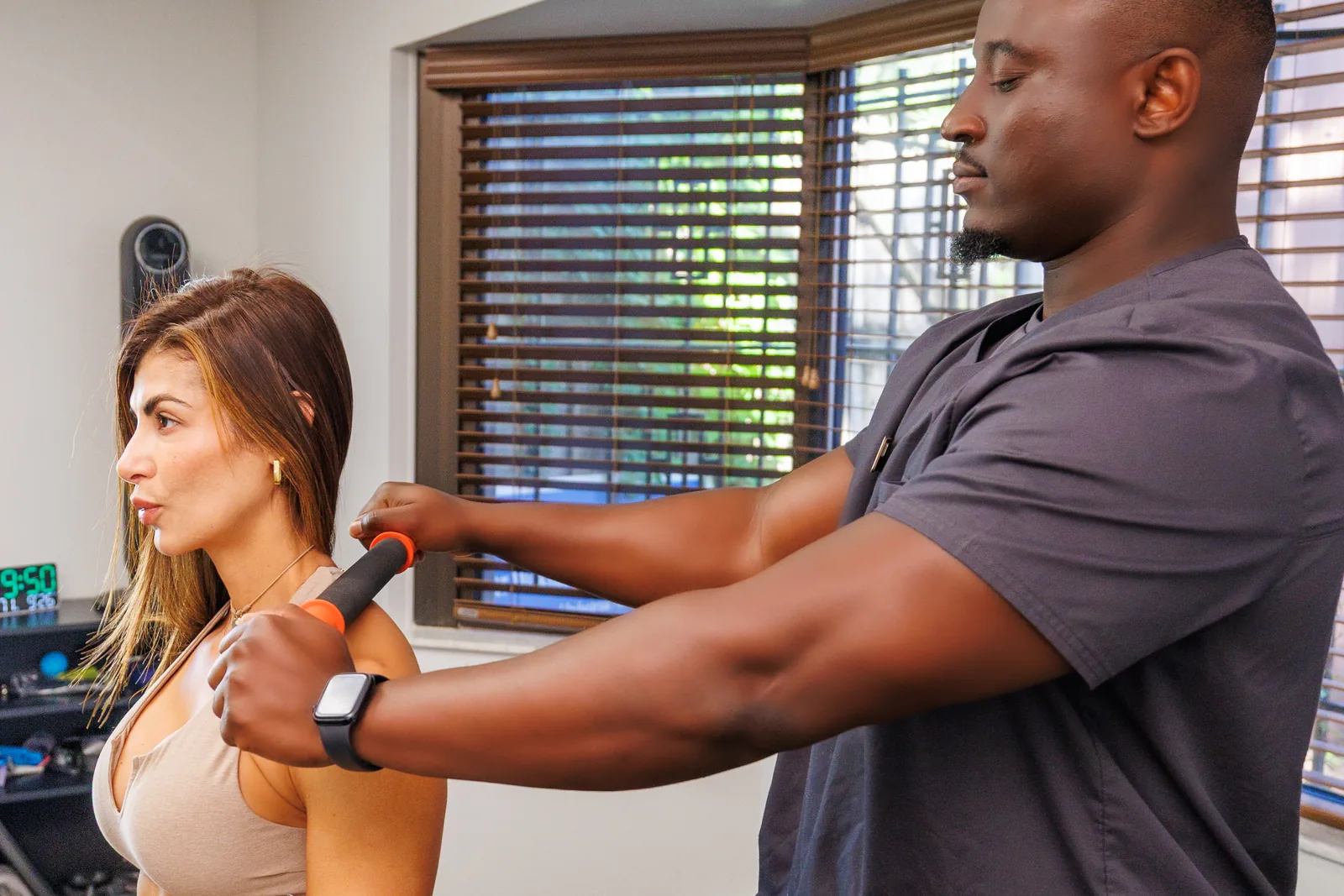
In my words from the clip on fascia: doing myofascial release is not enough on a knot like that, so we have to be very specific and dig deeper. Sometimes I go in with the elbow so I can hit it properly, and I have you breathe, because that is how you supply oxygenated nutrients to the muscle. The rule is the same for an elbow as for a thumb: on a scale of one to ten, ten being pain, we do not want ten. We want everything around five, and you tell me the moment you get there.
That's what the trigger point therapy in Tampa page describes session by session, and the myofascial release page covers the wider fascia work around it. For the plain explanation of fascia itself, read what myofascial release is.
What we see at the table in Tampa
The first question I ask is what you do for work, because the answer tells me where the knots are before I touch you. Desk: trapezius and hip flexors. On your feet all day: calves and lower back. Lifters: whichever side you favour, and you do favour one. Here is what that has looked like for real people.
- The woman who woke up at an eight. Scoliosis since 2012, lower back pain at eight out of ten every morning. Therapeutic breathing first, then assisted stretching, myofascial release and trigger point therapy together. Today she wakes up without pain; she can landscape, she can travel. My own words on camera, on the reviews page.
- The tightness other treatments barely touched. "I've had tightness and problem areas that other treatments barely touched, and Deen was able to get real results. Not only did I leave feeling looser and more mobile, but the improvements actually lasted." Brandon Buck, Google review, April 2026.
- Years of tension. "OMG. HE IS INCREDIBLE. Years of tension released from my body." Amanda Gabbard, Google review, April 2026.
- The one who named the method. "He can read a body and know exactly where the pain is coming from. He beats me up in the best way, and always reminds me to keeeeeeeep breathing." Abby Gail, Google review, August 2026.
- The oil change. "Would you drive your car without an oil change for 28 years?! That's basically what I was doing before coming to StretchOut." Erin Franklin, Google review, April 2026. I have nothing to add to that one.
Muscle knot questions, answered straight
How long do muscle knots last?
A fresh knot usually eases within days with movement, heat and pressure. WebMD puts the range at a day to several weeks, and the Cleveland Clinic says myofascial pain can clear in days to a few weeks with treatment but can take longer for some people. A knot that has been there for a year, through two foam rollers and a new chair, isn't going to leave by itself; it needs sustained pressure, the stretch after it, and a change to whatever keeps making it.
Do muscle knots pop when you press them?
No. What practitioners look for is a twitch, called the local twitch response, when the taut band is pressed or snapped sideways; it's one of the signs used to confirm a trigger point. A pop or crack is a joint moving, not a knot releasing. A knot letting go feels like the pressure fading under the thumb over a few breaths.
Could the lump be something other than a knot?
Yes. A knot sits inside a muscle, is sore when pressed, and moves with the muscle. A lump that's hot, red, growing, painless, or sits near the neck, armpit or groin alongside a cold or an infection could be a swollen lymph node or a cyst, and that goes to a doctor this week, not to a stretch table. Deen will say so on day one if something doesn't feel like muscle.
Is deep tissue massage good for muscle knots?
Not always. The physical therapist WebMD interviewed warned that forceful strokes can irritate a knot and add restriction and pain. Sustained pressure held into the point, followed by a stretch, is a different thing from rubbing hard over it, and it's the method the compression research tested. At StretchOut Wellness the pressure is held, not rubbed, kept around a five out of ten, and followed by the stretch through the new range.
Does trigger point therapy hurt?
It's intense for a few breaths, then it fades as the point lets go. Deen keeps the pressure at about a five out of ten on your own scale, never a ten, and asks you to say the moment you reach it. You breathe the whole time, because a muscle you brace against never releases. A little next-day tenderness after a first visit is normal; pain that's worse the next day is not, and he wants to hear about it.
How many sessions does a knot take?
Day one tells you. It's a 60-minute assessment plus the release work your body needs that visit, and you leave with homework. Four reviews describe feeling the difference in the same session, and two describe lasting change inside the first month. A knot that has been there for years takes longer, and the two or three homework moves between visits do much of the work. There's no package to buy up front; the first visit is $70.
Find the knot that is actually responsible
The first visit is 60 minutes for $70: the conversation about what you do all day, the whole-body assessment, the release work on the knot that is behind the pain, the stretch through the new range, and homework for the morning and for your desk.
Trigger point therapy in Tampa · Myofascial release · All services

Founder of StretchOut Wellness and creator of the Functional Mobility Technique. Certified Functional Mobility Specialist. Works one-on-one with every client at the Tampa studio, rated 5.0 on Google across 26 reviews. About Deen · Contact
Sources
- Tantanatip A, Chang KV. Myofascial Pain Syndrome. StatPearls, NCBI Bookshelf (trigger points, referral patterns, local twitch response)
- Hammi C, Schroeder JD, Yeung B. Trigger Point Injection. StatPearls (knots in a taut band, first described by Janet Travell in 1942)
- Shah JP, Phillips TM, Danoff JV, Gerber LH. An in vivo microanalytical technique for measuring the local biochemical milieu of human skeletal muscle. J Appl Physiol, 2005
- Quintner JL, Bove GM, Cohen ML. A critical evaluation of the trigger point phenomenon. Rheumatology, 2015
- Physiopedia, Trigger Points (energy crisis model, active and latent points, causes)
- Couppe C, Torelli P, Fuglsang-Frederiksen A, et al. Myofascial trigger points are very prevalent in patients with chronic tension-type headache. Clin J Pain, 2007
- Skootsky SA, Jaeger B, Oye RK. Prevalence of myofascial pain in general internal medicine practice. West J Med, 1989
- Cleveland Clinic, Myofascial Pain Syndrome (causes, up to 85 percent lifetime, duration), reviewed June 2023
- Mayo Clinic, Myofascial pain syndrome, symptoms and causes, January 2024
- WebMD, What to Know About Muscle Knots, reviewed August 2025 (the interview with physical therapist John Gallucci Jr)
- Healthline, How to Treat and Prevent Muscle Knots, updated February 2023
- Lu W, et al. Effect of ischemic compression on myofascial pain syndrome: a systematic review and meta-analysis. 2022 (11 studies, 427 subjects)
- Effectiveness of ischemic compression on myofascial trigger points: a systematic review. J Back Musculoskelet Rehabil, 2023
- Cheatham SW, Kolber MJ, Cain M, Lee M. The effects of self-myofascial release using a foam roll or roller massager on joint range of motion, muscle recovery, and performance: a systematic review. Int J Sports Phys Ther, 2015
- Simons DG, Travell JG, Simons LS. Myofascial Pain and Dysfunction: The Trigger Point Manual, 2nd edition, 1999 (the referred-pain maps)