
What is myofascial release? What it is, what it feels like, and what the research says
I'm Deen Ali. Myofascial release is in every session I do at StretchOut Wellness in Tampa, rated 5.0 on Google across 26 reviews, and one client's review gave me a job title I didn't ask for: "the fascia whisperer".
| Method | What happens | How long the pressure lasts | What it's aimed at | Who does it |
|---|---|---|---|---|
| Myofascial release | Slow, sustained pressure held into the connective tissue, no oil | A minute or more per area; research protocols use 2 to 5 minutes | Stiff, restricted fascia around a muscle | A trained practitioner's hands |
| Trigger point therapy | Direct pressure on one knot until it lets go | 30 to 90 seconds | A single tender point that refers pain elsewhere | A practitioner, with a thumb or an elbow |
| A relaxation massage | Gliding and kneading strokes, usually with oil | Moving the whole time | Whole muscle groups and general relaxation | A massage therapist |
| Foam rolling | Your own body weight rolled over a foam cylinder | 30 to 60 seconds per area | Big muscles, a short-term gain in range | You |
| Assisted stretching | Someone moves the limb to lengthen the muscle | 30 seconds or more per stretch | Muscle length and joint range | A practitioner |
Timings from the 2015 review of myofascial release trials, the 2022 meta-analysis of compression studies and the 2015 review of foam rolling, all listed at the end. At StretchOut Wellness the first, second and fifth rows happen in the same session.
What is fascia?
Fascia is the thin, strong connective tissue that wraps and connects every muscle, bone, nerve and organ as one continuous sheet. It's mostly collagen, in layers that slide on a fluid called hyaluronan. Healthy fascia stretches with you. Stiff fascia restricts the muscle underneath and can cause pain somewhere else in the body.
The Cleveland Clinic compares it to a spider web woven through everything. An anatomy teacher would hand you an orange and point at the white stuff between the segments. I say it on camera in one line: fascia is a connective tissue that networks the entire body. The word that matters to you is "networks". Because it's one sheet, a snag in one place pulls on another, which is how a tight hip ends up filed under "bad back".
It behaves like a fitted sheet. Pull one corner tight and the opposite corner lets go of the mattress, usually at six in the morning, usually on your side. (I don't make the rules. The sheet does.)
What stiffens it, according to the Cleveland Clinic: inflammation and trauma dry up the fluid between the layers, so they stop sliding. Its advice for keeping fascia healthy is to move, stretch and stop slumping, which tells you what the everyday cause is. Nobody's fascia was improved by a nine-hour meeting.
What happens in a myofascial release session?
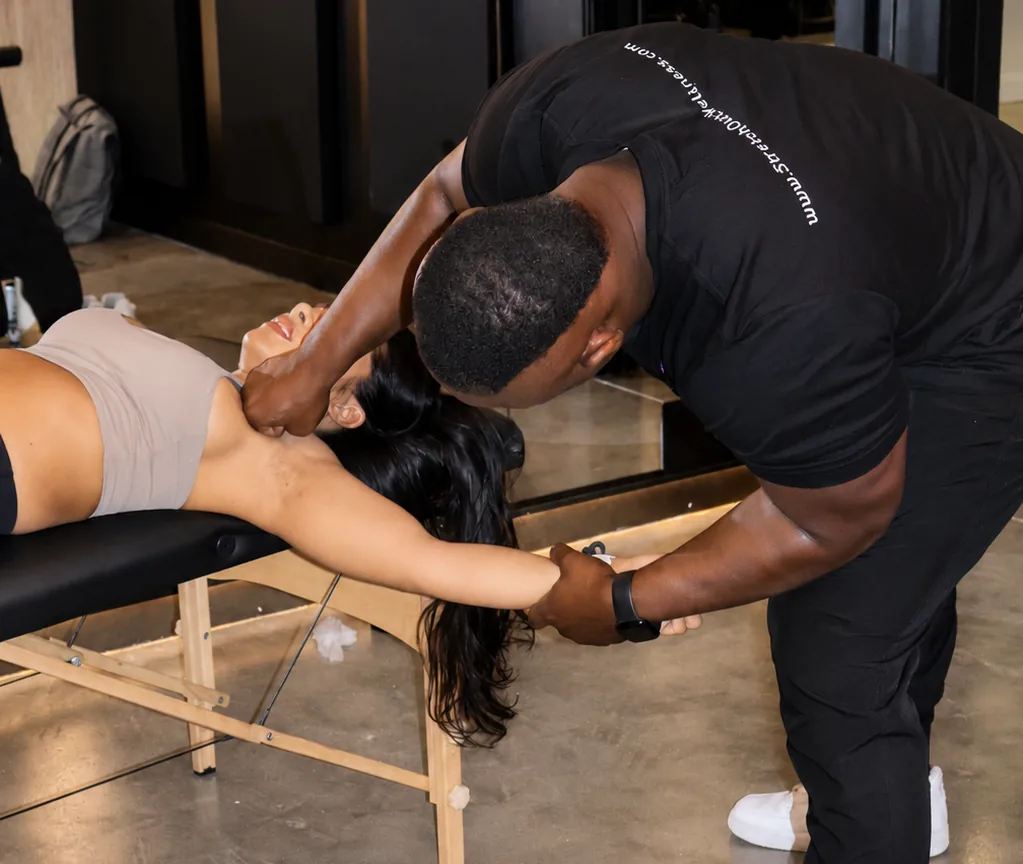
The practitioner finds an area of fascia that feels stiff instead of springy, then applies slow, sustained pressure to it by hand, with no oil, and waits for the tissue to soften. Research protocols hold for two to five minutes. Once it lets go, the muscle is moved or stretched through the new range. A clinical session runs 15 to 50 minutes.
That's the textbook version. On my table it's one part of a 60-minute session, and it comes early. In my words from the trapezius clip: our client sits for work, so she carries a lot of tension in her trapezius towards her neck, and we start with myofascial release there so we can warm up the entire area before we start stretching. Release first, stretch second. A muscle that's still wrapped tight doesn't stretch. It argues.
There are two schools. Direct release sinks into the restriction with knuckles, a forearm or an elbow and a few kilograms of force. Indirect release uses a few grams and follows the tissue wherever it wants to go. I work direct, to about a five out of ten on your own scale, never a ten, and you tell me the moment you're there. You breathe the whole time, because that's how you supply oxygenated nutrients to the muscle.
What does myofascial release feel like?
Intense, not painful. It feels like slow, deep pressure and a stretching or warming sensation that builds for a few breaths, then fades as the tissue softens. Most people feel looser straight away. Mild soreness the next day is normal and passes quickly, the Cleveland Clinic notes. Sharp pain isn't part of it, and you say so if it shows up.
A client put the sensation better than a textbook does: "His technique is incredibly effective - targeted, intentional, and you can feel the difference almost immediately." That's from Brandon Buck's review in April 2026. "Targeted" is the word I'd keep. It isn't a rub. It's one place, held, until that place changes its mind.
On camera, working on a shoulder, I say the quiet part out loud: look at her face, wherever she's restricted, she'll show it on her face. Everybody thinks they have a poker face on the table. Nobody has a poker face on the table.
Does myofascial release work?
The research is promising and mixed. A 2021 meta-analysis of eight trials and 375 people with chronic low back pain found it improved pain and physical function. A 2018 review concluded the evidence wasn't yet sufficient for chronic musculoskeletal pain in general. The trials are small and the technique varies between practitioners, which is why the results vary too.
I'd rather show you the split than pretend there isn't one. On one side, a 2015 review of the randomized trials called the results encouraging and the quality mixed. The 2021 meta-analysis found real improvements in pain and physical function for chronic low back pain, and none in balance, trunk mobility or quality of life. A second meta-analysis the same year agreed on function and didn't find the pain effect. On the other side sits the 2018 review, which said: not enough yet.
The Mayo Clinic's explanation for the mess is the most useful sentence in the whole literature. Few studies have tested it specifically, it says, partly because the technique varies from therapist to therapist. In other words, "myofascial release" in a trial is whatever that trial's practitioner did with their hands. It's like reviewing "dinner". Depends who cooked.
So I won't tell you a journal has settled it. What I can tell you is what happens on one table in Tampa, with the same hands every time, and that's two sections down.
Is myofascial release the same as massage, foam rolling or trigger point therapy?
No. A relaxation massage glides over the muscle with oil. Myofascial release holds slow pressure into restricted connective tissue with no oil. Trigger point therapy presses one specific knot until it lets go. Foam rolling is the do-it-yourself version, using body weight on a roller. Assisted stretching lengthens the muscle without pressing into it. The table above lines them up.
You'll see the Cleveland Clinic call myofascial release and trigger point therapy the same thing, and plenty of practitioners use the words that way. I separate them, because they do different jobs on my table. Myofascial release opens up an area. A trigger point, in other words a knot, needs something more specific. From my clip on fascia: there's a myofascial trigger point right here, and doing myofascial release is not enough, so we have to be very specific and dig deeper. That's the moment the elbow gets involved. The muscle knots post covers that half, and the trigger point therapy page shows it session by session.
Foam rolling earns its place. A 2015 review found 30 to 60 seconds of rolling improves range of motion for a while afterwards, and it's free after the first $25. What it can't do is find the restriction for you, or hold still on it for three minutes while you breathe. A roller has no opinions about your left hip. I have several.
Who shouldn't have myofascial release?
People with a fracture, a burn, an open wound, a deep vein thrombosis, a condition that needs blood thinners, or certain metabolic conditions should talk to their doctor first, the Cleveland Clinic advises. Serious complications are rare. Myofascial release at a wellness studio isn't medical care, so an injury or a diagnosis goes to a doctor before it goes to a table.
That last sentence is in our terms of service, and I mean it. Many clients come after physical therapy has finished, or alongside it, and bring their doctor's guidance to day one. If something under my hands doesn't feel like muscle or fascia, I'll say so, and you see your doctor before we go any further.
What we see at the table
Four of the 22 written reviews name the fascia work specifically, which is unusual for a word most people can't spell on the first try. Here's what they describe, and what I'd add.
- It starts with an explanation. "He takes the time to understand exactly what's going on in your body and explains everything in a way that actually makes sense." Brandon Buck, Google review, April 2026. If you don't know why I'm on your hip when your back hurts, I haven't done my job yet.
- It goes where it's needed, not everywhere. "He was professional, knowledgeable, and took the time to focus on the areas that needed attention." Pawan Agarwal, Google review, October 2026.
- Tight muscle is a performance problem too. "As a competitive bodybuilder, I deal with tight muscles that can limit my posing, flexibility, and overall performance." Jared Goertzen, Google review, July 2026. People come for more than pain.
- The assessment comes first. "He will assess your issues and address them with his expertise." virginia Wyatt Schwartz, Google review, August 2026.
The numbers from this room: the pressure sits at about five out of ten, never ten. The release is never billed separately. And it's followed in the same hour by the stretch through the new range, because the gain you don't use on the table is the gain you lose on the drive home down Dale Mabry.
Myofascial release questions, answered straight
How long does a myofascial release session take?
The Cleveland Clinic gives 15 to 50 minutes for a clinical session. At StretchOut Wellness it's part of a 60 or 90 minute Functional Mobility Technique session, alongside trigger point work, assisted stretching and breathing, so the release is followed straight away by the stretch through the range it opened.
How often should you have myofascial release?
It depends on what the first visit finds. Clinical guidance ranges from every few days for a short spell to weekly. Most clients here start weekly while the restrictions come down, then move to every two to four weeks, with two or three homework moves between visits. There's no package to buy up front.
Does myofascial release hurt?
It's intense, not painful. Deen works to about a five out of ten on your own scale, never a ten, and asks you to say the moment you get there. You breathe through the pressure the whole time. Mild next-day soreness is normal; sharp pain isn't part of it, and he wants to hear about it straight away.
Can I do myofascial release on myself?
Partly. A foam roller or a ball is self-myofascial release, and a 2015 review found 30 to 60 seconds per area improves range of motion for a short time. It works best on big muscles and fresh tightness. It can't assess you, it can't find the restriction that's causing the one you can feel, and stubborn areas usually need hands.
What does myofascial release cost in Tampa?
At StretchOut Wellness it's included in every session, never billed separately. The first 60-minute visit is $70, half the usual $140. After that it's $140 for 60 minutes or $200 for the 90-minute extended reset. Prices as listed on the booking page in October 2026.
Have it done once, properly
The first visit is 60 minutes for $70: the conversation about what you do all day, the whole-body assessment, the release work on the areas that need it, the stretch through the range it opens, and homework for the morning and for your desk.
Myofascial release in Tampa · Trigger point therapy · All services

Founder of StretchOut Wellness and creator of the Functional Mobility Technique. Certified Functional Mobility Specialist. Works one-on-one with every client at the Tampa studio, rated 5.0 on Google across 26 reviews. About Deen · Contact
Sources
- Cleveland Clinic, Myofascial Release Therapy, reviewed August 2022 (what it is, what a session involves, who should avoid it)
- Cleveland Clinic, Fascia, reviewed June 2022 (what fascia is made of and what stiffens it)
- Mayo Clinic, Myofascial release therapy: can it relieve back pain?, March 2025
- Ajimsha MS, Al-Mudahka NR, Al-Madzhar JA. Effectiveness of myofascial release: systematic review of randomized controlled trials. J Bodyw Mov Ther, 2015
- Laimi K, Makila A, Barlund E, et al. Effectiveness of myofascial release in treatment of chronic musculoskeletal pain: a systematic review. Clin Rehabil, 2018
- Wu Z, Wang Y, Ye X, et al. Myofascial release for chronic low back pain: a systematic review and meta-analysis. Front Med, 2021 (8 trials, 375 people)
- Chen Z, Wu J, Wang X, et al. The effects of myofascial release technique for patients with low back pain: a systematic review and meta-analysis. Complement Ther Med, 2021
- McKenney K, Elder AS, Elder C, Hutchins A. Myofascial release as a treatment for orthopaedic conditions: a systematic review. J Athl Train, 2013
- Lu W, et al. Effect of ischemic compression on myofascial pain syndrome: a systematic review and meta-analysis. 2022 (compression held 30 to 90 seconds)
- Cheatham SW, Kolber MJ, Cain M, Lee M. The effects of self-myofascial release using a foam roll or roller massager: a systematic review. Int J Sports Phys Ther, 2015